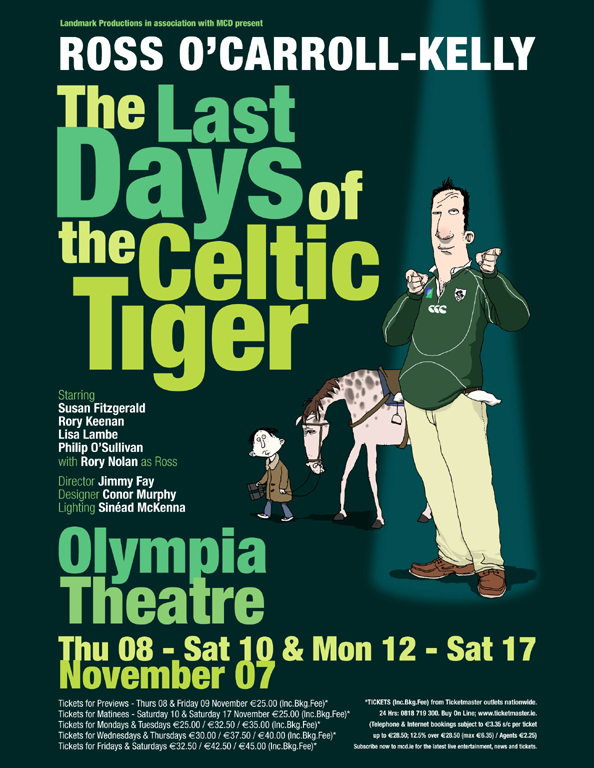
The Irish "Celtic Tiger" economy of 1995 to 2008
was one of the great capitalism success stories
in the world.
Average wealth doubled from 1994 to 2006.
Average wealth tripled from 1986 to 2006.
This drove the Irish left completely mad.
They hated the Celtic Tiger from the start.
Year after year, from 1995 to 2008, the left endlessly sneered at the Celtic Tiger,
pointed out its flaws,
and seemed to long for it to end.
Ireland remains a low-tax, high-tech, English-speaking, globalised economy.
Irish prosperity is not over.
But we need a government that puts Ireland first,
refuses to pay off debts that are not ours,
and dumps the Euro, and even the EU, if necessary.
The Irish left and the Dublin 4 media
love intellectuals whose policies have never helped the poor,
but they
hate
anyone who actually did anything for the poorer people of Ireland,
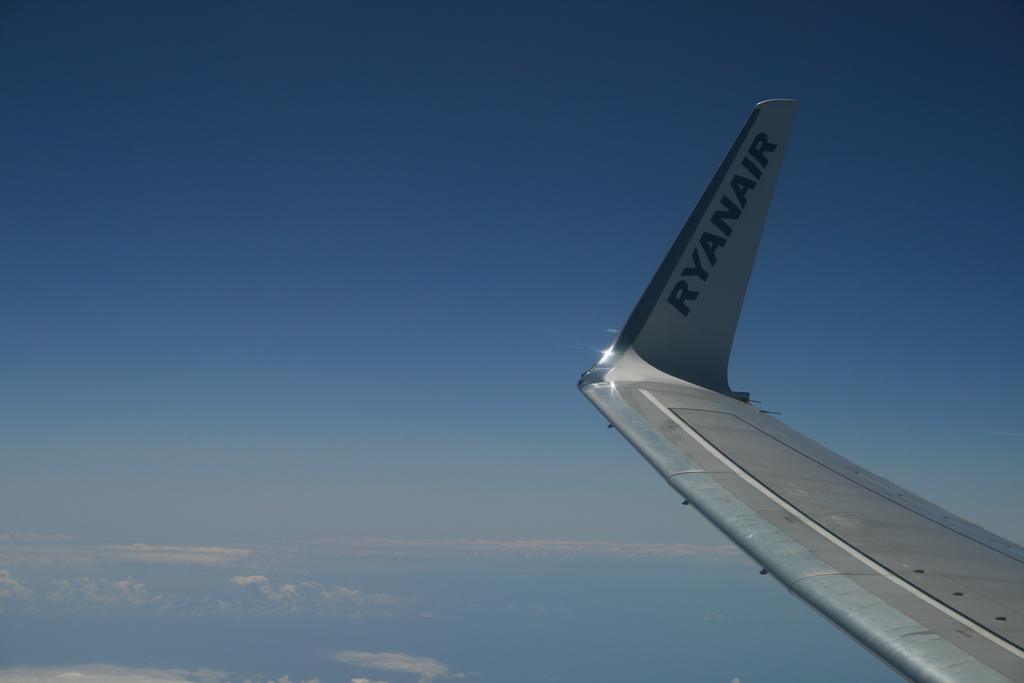
such as Ryanair,
which allowed the poorer people of Ireland to travel.
Image from here.
See terms of use.
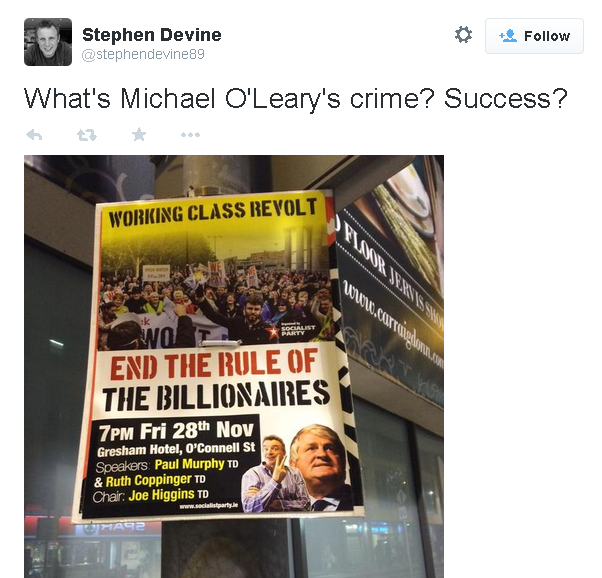
Irish commies are furious with Michael O'Leary
because he made it possible for the poorer people of Ireland to travel abroad.
From here.
The Republic of Ireland is ranked by
the Heritage Foundation
as the 4th most economically free country
in the world.
It is freer than the US, the UK,
and all of Europe.
Why Ireland Boomed,
James B. Burnham,
The Independent Review, Spring 2003.
He argues that EU money was a minor factor in Ireland's boom,
and that it was caused by an embrace of the market
- almost by chance rather than by ideology
- plus a number of lucky external factors.
He discusses in particular
the state monopolies in
telecoms
and
air flight
and how they crippled the Irish economy
until they were (thankfully) broken.
"For a generation after achieving independence from the United Kingdom in 1922,
Ireland sought to be economically self-sufficient. It relied on small-scale agriculture,
exporting primary produce to the U.K. market and manufacturing mainly for the home market
of less than 3 million people. Trade barriers such as high tariffs
and a policy of import substitution sought to make this reliance on economic nationalism successful.
Inevitably, it failed."
He considers the origin of Irish prosperity to be
T.K. Whitaker
and his landmark paper, Economic Development,
in 1958.
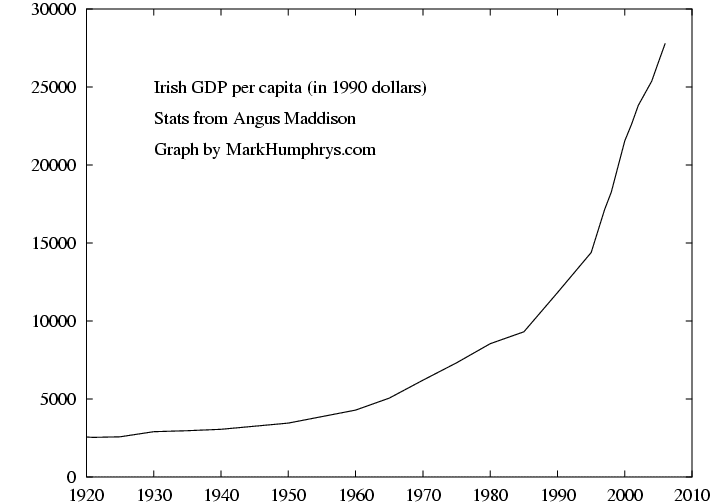
GDP per capita of Ireland
since 1922.
GDP per capita was
(1990 $) 2,736 in 1913,
and
(1990 $) 3,092 in 1947.
That is,
Ireland was hardly any richer in 1947 than it was in 1913.
But things got a lot better after that.
Stats from Angus Maddison.
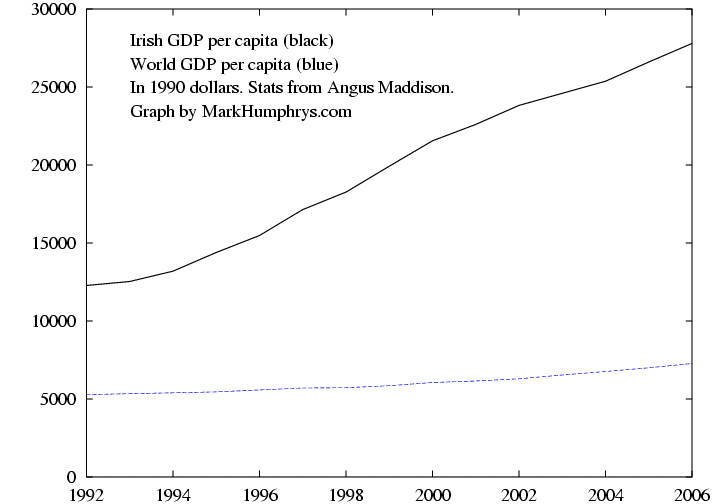
Close-up of recent years.
Average wealth doubled from 1994 to 2006.
Average wealth tripled from 1986 to 2006.
World GDP per capita actually grew
quite well during this period,
as you can see if you
change the scale.
It's just that Irish growth was so amazing it makes world growth look almost flat.
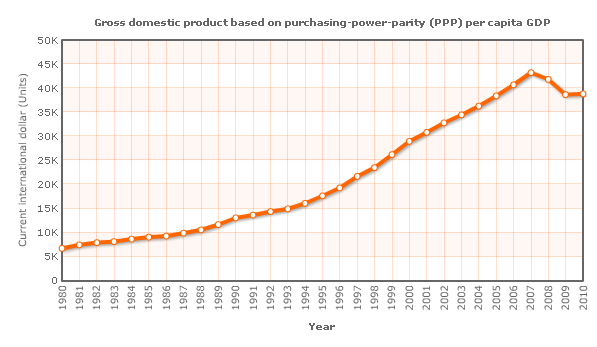
GDP - per capita (PPP).
Update showing after the 2008 crash.
GDP per capita in 2010 had fallen back to 2005 levels.
After the Ball,
by Fintan O'Toole, 2003,
exemplifies the yearning desire of the Irish left
to see the boom come to an end.
Here is a man - like many others - who did nothing but complain
as Ireland transformed from a land of emigration and unemployment in the 1980s
to one of the richest countries on earth.
By his ideas, he did everything he could to stop this happening.
He has been heaping abuse on the "Celtic Tiger"
for years.
And now, one brief economic slowdown
and he produces this book
with its sneering title,
delighted that the "Ball" is over,
gloating that at last, he may be proved right.
But of course, the good times aren't over.
The Celtic Tiger isn't ending.
Prosperity isn't ending.
And it's Fintan O'Toole who will look bitter and foolish.
Thank heavens Ireland isn't run by narrow men like him.
It used to be, in the days of de Valera.
But not any more.
Just some of hundreds of articles I could have chosen to illustrate that
you should not rely on people like Fintan O'Toole for your prediction
of what will happen next.
He once angrily replied to criticism that
his ludicrous anti-capitalist economic policies
would lead to a lower standard of living.
Like Arafat,
or Castro, or any other economy-wrecker,
De Valera blithely said:
"You say "lower" when you ought to say a less costly standard of living. I think
it quite possible that a less costly standard of living is desirable and that
it would prove, in fact, to be a higher standard of living. I am not satisfied
that the standard of living and the mode of living in Western Europe is a right
or proper one."
And de Valera delivered the poverty that he praised.
Irish GDP stagnated under de Valera,
who was head of government from 1932 to 1948,
then 1951 to 1954,
then 1957 to 1959.
It only started to really grow after he left office in 1959.
His long period in office in particular was a disaster.
GDP per capita (in 1990 dollars) was $2,972 in 1931.
It was $3,092 in 1947.
While praising the poverty the Irish lived in,
De Valera himself of course lived in a succession of two beautiful
houses (Bellevue and Herberton)
on Cross Avenue
in Blackrock.
I would love to be able to live on Cross Avenue!
"Please God let it be true", you can hear the left praying,
that the Celtic Tiger ends.
"Please let this appalling, distasteful wealth end!"
The Irish left, which always hated Irish prosperity,
has been hopefully
predicting the end of the Celtic Tiger since the very start in the 1990s.
Search for the phrase
"end of the celtic tiger"
in the news.
After hopefully predicting its demise for years,
the left finally got their apparent victory in 2008.
Damien Dempsey
produced a hilarious song called
"Celtic Tiger"
in 2003,
with Sinead O'Connor.
I can sum it up as follows:
Free-market capitalism ends
unemployment and emigration.
Artist is not happy but rather whines about it.
Sinead O'Connor is of course very wealthy:
In 2007,
Sinead O'Connor paid
almost €2m
for a 6-bedroom, 3,200 square foot
Victorian house
overlooking the sea at Bray.
I love her voice and her music,
but I am afraid
she is part of an age-old tradition of rich people telling the rest of us
not to be rich.
His song
"Colony" (2000)
treats Ireland as if it is some oppressed third-world nation!
"We had a civilisation;
When they were still neanderthal nations;
We suffer with the Native American, the Indian in Asia;
Aboriginal Australia;
The African people with their history so deep;
And our children still weep and our lives are still cheap".
What planet is he on?
Ireland is one of the richest countries in the world.
Millionaire artists
Millionaire artists
often attack the free market system and the country that made them wealthy.
I would prefer them if they just enjoyed their wealth and were grateful.
Millionaire actress
Natalie Portman, Aug 2009, says the recession, and people losing their jobs, is
"kind of an exciting time.
I mean, everyone is cutting back. It's happening in every industry - including our own. All of a sudden, people are doing jobs that they hate and they're not making as much money as they thought they would or they've lost their jobs entirely. I've started to see people looking more toward their own passions and what really excites them."
One day later,
she buys a $3 m mansion
in a gated community in LA.
(She just sold her Manhattan home for nearly $7 m.)
Millionaire actor Ben Affleck, Dec 2010, says salaries in banking and business are disgraceful:
"The banks shouldn't - people shouldn't make such a giant profit off just moving money back and forth.
And CEOs' pay shouldn't be 200 times the average worker. It used to be nine times."
He, of course,
gets paid millions of dollars
for acting,
while the lighting and camera people earn almost nothing.
He was paid $10 million for acting in the useless
The Sum Of All Fears.
He was paid $12.5 million for acting in the flop
Gigli.
He was paid $1.5 million for doing commercials for L'Oreal Shampoo.
R&B artist
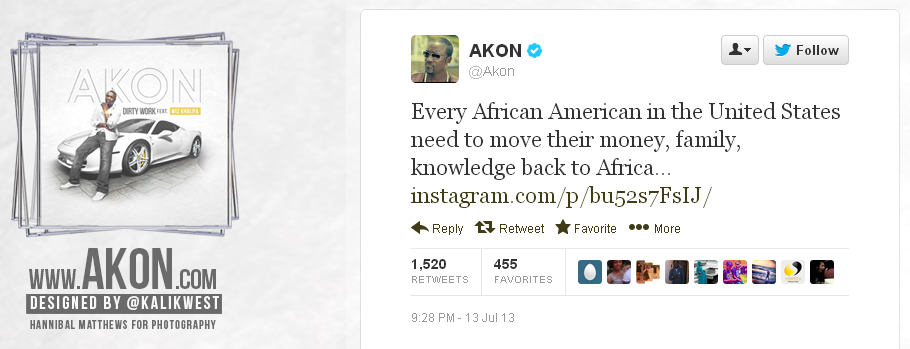
Akon
was made rich beyond his wildest dreams by American capitalism.
He is worth
$80 million
and
lives in this mansion.
Angry at the acquittal of
George Zimmerman in July 2013,
Akon tweets
that "Every African American in the United States need to move their money, family, knowledge back to Africa".
He explains further
that
"Every African American in the United States need to move their money, family, knowledge back to Africa were u will be treated like the royalty you are. You don't deserve this treatment. This is not your country!!"
Note that his twitter page features his
white Ferrari 458 Italia.
Browne admits that Ireland implemented free-market economic policies during the boom:
"We also got a country that seemed willing to be governed by the ideology of the Progressive Democrats, albeit without ever voting for that party in large numbers."
He admits that Ireland got much richer. He's not crazy enough to deny that!
He claims this was a coincidence.
"As the proud boasts from media and business leaders about how neoliberal policies created the boom fade away, we are forced to admit that "success" was probably due to highly contingent circumstances, none of which were within our control, making them unlikely to be repeated. So there's literally no way back to prosperity, or not any way that we can map."
Some coincidence!
Harry Browne sums up the Irish left's approach to empirical questions.
He sneers at 20 years of the greatest prosperity in Irish history:
"But instead of a radical upheaval, we got Fianna Fail kicking off more than two decades of semi-permanent government with savage cuts in healthcare."
And despite the empirical track record of free-market economics in generating wealth
- which extends far beyond just Ireland
- he calls for a - yes - socialist revolution.
Yes, that will make us all richer.
Let's look again at GDP per capita of Ireland
since 1922.
In 2003, Fintan O'Toole
sneered that the "ball" was over for Ireland.
In 2009, Eddie Holt
sneered that capitalism was finished:
"consumerism has consumed itself. For about 20 years - since the collapse of socialism - it was inevitable anyway. It was just a matter of time."
Yeah, right.
What a dream world these left-wing intellectuals live in.
What lack of gratitude
for the incredible prosperity that Fianna Fail and the PDs have delivered.
If they just openly said:
"I hate Ireland being rich and I want it to be poor",
then at least I could respect them for being honest.
But they never say anything so direct.
They just sneer at the people who made Ireland rich.
I am no economist, and it is hard for me to judge among the competing explanations for the Irish crisis.
I do not find these convincing as causes:
Greed.
The free market.
Lack of market regulation.
Lack of state interference.
Low tax rates.
I find these explanations more convincing:
Lack of Irish government control over our currency exchange rates.
We gave up control of our own currency when we joined the Euro.
Lack of Irish government control over our interest rates.
We gave up control of these to Europe too.
In summary, Ireland giving up control of its
monetary policy
to the EU, which was not concerned with Ireland's interests.
The government decision to bail out the banks.
In particular the decision to bail out the useless Anglo Irish Bank.
While letting a bank fail might have costs,
it seems that bailing out this bank was far worse, not better,
for the Irish economy
than letting it fail.
The government decision to protect not just Irish citizens
but also foreign investors and speculators.
While Cowen's FF was rightly blamed,
the Irish people seem to have a mental block about blaming the EU and the Euro.
Richard Waghorne, 28 Feb 2011, is depressed about the 2011 election:
"there has been no mainstream acknowledgement that rampant Europhilia and the catastrophic Irish decision to join the Euro are root causes of Ireland's supplicant helplessness today. Despite the centrality of the EU membership and the euro to any analysis of the causes of the Irish crisis, neither properly became an election issue in their own right."
I am no economist, but it does seem to me that
the Euro
was introduced for political reasons, independent of whether it helped the economy.
And it seems to me now that for political reasons,
the Euro will never be abandoned by the EU,
even if it is not working economically.
I would prefer a detached attitude to the Euro.
If it works economically, keep it.
If not, return to national currencies.
I don't care either way.
I only care what works for the economy.
But unfortunately, not only will the EU never have such a detached attitude,
neither do any of the Irish political parties.
Fianna Fail
made the taxpayer take on massive private debts
to save the Euro.
That is, Fianna Fail
cared more about the great EU political project than about the Irish economy.
But unfortunately, everyone in Irish politics feels the same.
Eduardo Porter, May 15, 2012, makes sense to me on the Euro. Why does no one in Ireland write like this?
"Social upheaval across the euro area suggests that it may be time to call it quits and try to work out an orderly process to re-establish national currencies throughout the bloc.
Europe would be in much better shape if the euro didn't exist and each member country had its own currency.
Monetary union has shackled together nations with vastly different economies, depriving them of an independent monetary policy that can help them through rough times."
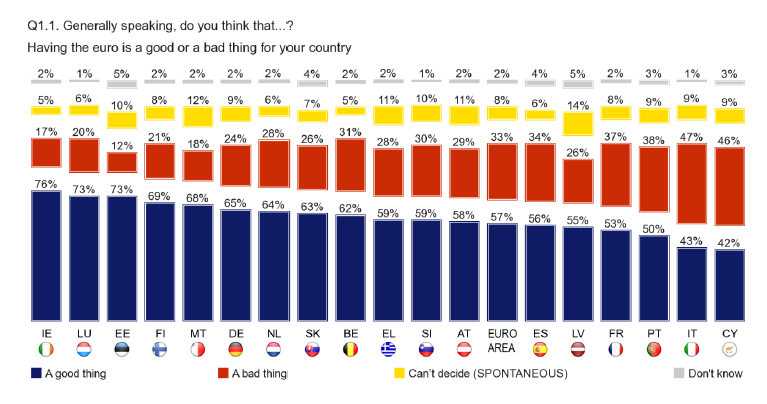
Poll, Oct 2014.
6 years after the Euro destroyed the Irish economy, Irish people still love the Euro.
They clearly blame other causes for the 2008 crash.
An incredible
76 percent of Irish think the Euro is a good thing for Ireland.
Only 17 percent think it is a bad thing.
In fact,
Ireland is the most pro-Euro country in Europe.
No wonder I can't find anyone to vote for.
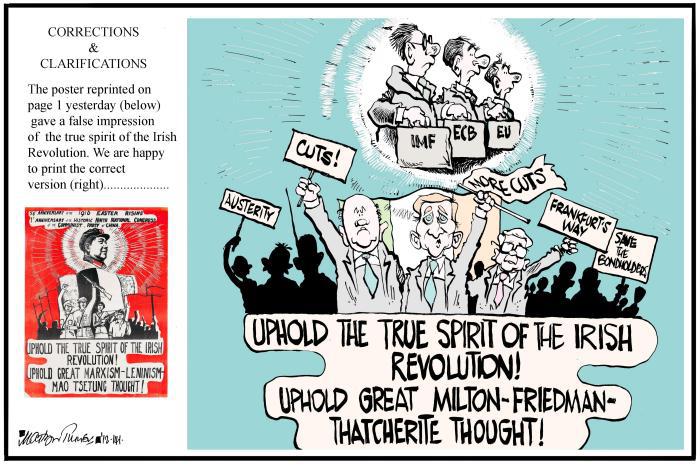
After the discovery of a
Maoist poster praising the Irish revolution of 1916,
Martyn Turner produced this cartoon in the Irish Times, 4 Oct 2012.
This bizarre cartoon
shows the determination of the Irish left to blame capitalism (rather than the EU
and the euro project) for the Irish crisis.
As if
Milton Friedman and
Margaret Thatcher
would have been in favour of saving the Euro project!
Contrary to Martyn Turner's left-wing ignorance,
Thatcher predicted the Euro would devastate small countries like Ireland.
She was a prophet back in the 1980s and 1990s, but no one listened.
Certainly Ireland did not listen to her.
She was entirely opposed to the Euro,
and her opposition brought about her downfall.
After 11 years as Prime Minister, she
lost her office trying to stop the Euro.
Peter Oborne
describes her as
"the first victim of the single currency".
And now ignorant left-wing cartoonists paint her as some kind of supporter of the European project!
In contrast, I bet that Martyn Turner himself was (like everyone else at the Irish Times)
a Euro-enthusiast.
I wonder can we find old cartoons by Martyn Turner poking fun at Euro-sceptics?
Maybe even a cartoon attacking Thatcher for opposing the European project in 1989-90?
Tell me here.
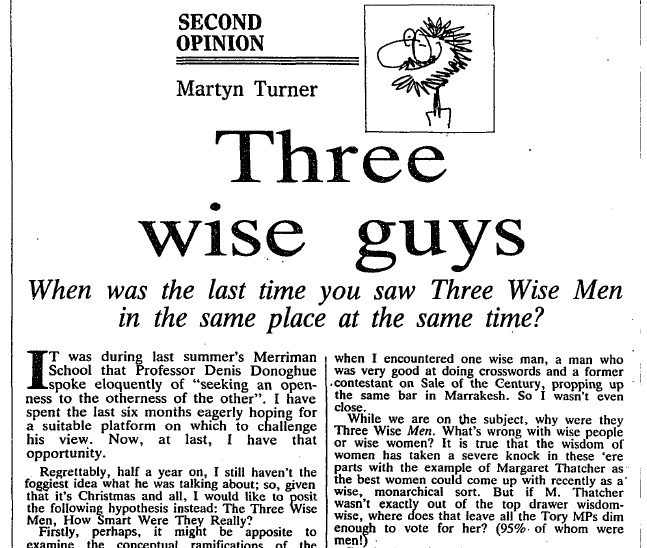
Martyn Turner attacks Margaret Thatcher's intelligence, Irish Times,
21 Dec 1991, p.29.
This was a woman who already - back then - had predicted the Euro crisis!
Whatever saving the banks is,
it is not capitalism.
Capitalism means letting failed businesses fail.
The taxpayer should not be paying for the mistakes of private business.
If you lend billions to absurd schemes that will never pay you back, tough luck.
You should lose the money.
The taxpayer should not help you.
The FF-Green government
spent tens of billions saving
Anglo Irish Bank.
David McWilliams articles
on the incredible sums spent by the FF-Green government on saving toxic banks.
There is a case to protect regular banks like AIB and Bank of Ireland.
You cannot let 3 million Irish citizens lose their life savings
because of reckless speculation by bankers.
But the people who should take the hit are the banks' creditors,
not the taxpayer.
And when it comes to Anglo, why should it be saved at all?
I do not understand why the government wanted to save Anglo.
I find the idea of the state bailing out bankers
just as disgusting as any communist does.
"My heart sank when I heard .. that the state was going to waste yet more of our money on Anglo. No one needs Anglo and, if we closed it down tomorrow, we'd miss it less than Hector Grey's. More to the point, the financial markets would reward, not punish, us.
Our government has indicated that it will have to put up to €20 billion into Anglo so that it can give this money to institutions that lent to Anglo.
...
But it's not my problem and it's not your problem: it is the Anglo investors' problem and, because they took a punt on Anglo, they should have to sort it out themselves.
...
the ''insiders'' who financed Anglo and were great capitalists four years ago, today don't trust the normal rules of capitalism to solve their problem. They have miraculously turned into Marxists."
"So, close it down. The financial markets will reward us, because that is one less debt that the Irish taxpayer will have to pay in the future.
The reason the markets will support closing down Anglo is that markets have no interest in an Ireland that turns itself into a debt-servicing machine to pay for the mistakes of yesterday.
There is always new money and, if someone has to lose on Anglo, well, so be it - that's the game. Move on.
...
In the past 12 months, 141 banks were closed down in America and no one noticed.
Close it and move on."
Anglo armageddon is a myth, David McWilliams, April 5, 2010:
"The financial markets want to see that Ireland is going to grow again. They want to invest in us, in our real abilities, the abilities of the people. Therefore, they want to see a strategy for growth. What they are seeing now is an illegitimate strategy, with no public support, which will turn Ireland into a large debt-servicing agency."
Vincent Browne takes on Klaus Masuch of the ECB, Jan 2012.
He may be a
socialist nutcase
on other issues,
but I agree with
Vincent Browne on this.
Why are Irish people being forced to pay billions to save European bondholders?
If we can survive this banking crisis,
Irish prosperity is not over.
The Celtic Tiger was not all about property.
It was also based on a low tax, high tech, smart economy.
Right now, even after the crash,
there are thousands of job vacancies in my sector
- computing in Ireland.
"Let's start with the seemingly incredulous fact that Ireland's GDP per capita last year was, despite an 8 per cent plunge that year, still the 2nd highest in the EU. It was also a staggering 31 per cent higher than the EU average.
...
on this, albeit imperfect, measure, Ireland's well-being is broadly back where it was in 2004."
"Employment in the economy is, at 1,859,000, ... settling at the levels prevailing in 2005, levels that are over a quarter of a million higher than in the year 2000 and 700,000 higher than in 1993."
The UN Human Development Index
for 2013
still ranks Ireland 7th in the world.
"It didn't generate a lot of publicity here, probably because it runs counter to the dominant media narrative of a country in the depths of depression.
...
When the index was first published in 1990 the UK was in 10th position and Ireland was in 17th."
"In a recent paper eminent economist Brendan Walsh explored how Ireland had fared on a range of indicators for wellbeing from the 1970s to 2011. One of his conclusions ... was that life satisfaction had not shown a marked decline between 2007 and 2011 ... While there was a small decline it was not as dramatic as that recorded in other crisis-stricken countries or during previous Irish recessions.
"Furthermore, contrary to expectations, other possible indicators of wellbeing, such as the suicide rate and admission rates to psychiatric hospitals, have not risen in line with the soaring unemployment rate, and the Irish fertility rate has remained high in the face of economic adversity. Overall, the impact of the current recession on wellbeing has been surprisingly small," concluded Walsh."
David McWilliams
has an interesting idea for Ireland's future
- open up the right to live and work here to the world-wide Irish diaspora.
Indeed, why not open up Ireland to all
of the US, Canada, Australia and New Zealand,
and maybe also places like Hong Kong, South Korea and Israel.
Let the best, brightest, most energetic and best-integrating
immigrants of the world come here.
Irish technology sector stifled by lack of key staff, by Chris Horn (of IONA Technologies), 12 Feb 2012,
on how, even in the recession, there are more job opportunities than people in IT in Ireland:
"on January 5 last, the CEO of the IDA .. noted that "there would have been more than 13,000 new jobs last year if there had been a greater availability in the skills arena".
I was surprised that the Government, the Opposition and the media did not focus on this critical observation.
At a time of high unemployment, huge emigration and cancerous national disillusionment, the head of the major State agency for inward investment asserts that new jobs and employment were held back only because of the lack of available people - and yet few seemed to hear, comment or respond to his message."
Strict immigration policy stifling tech innovation, summit told, 23 Jan 2013.
"Ireland's strict immigration policy is stifling tech innovation, entrepreneur and philanthropist Bill Liao has said.
At the Global Technology Leaders Summit in Cork yesterday, ... summit delegates ... were told Ireland is only producing half the computer science and engineering graduates the tech industry here needs.
Cisco senior vice-president Barry O'Sullivan told the delegates that there were currently more than 5,000 unfilled vacancies in Ireland. A lack of tech talent was "constraining the industry"."
Aug 2013 update: "Conservative estimates put the number of IT vacancies at 4,000."
RTE report on job vacancies in computing in Ireland, Apr 2009.
Contrary to all the leftie sneering that the boom is over,
there is (and has been for years)
a huge shortage of people for the thousands of open jobs in computing in Ireland.
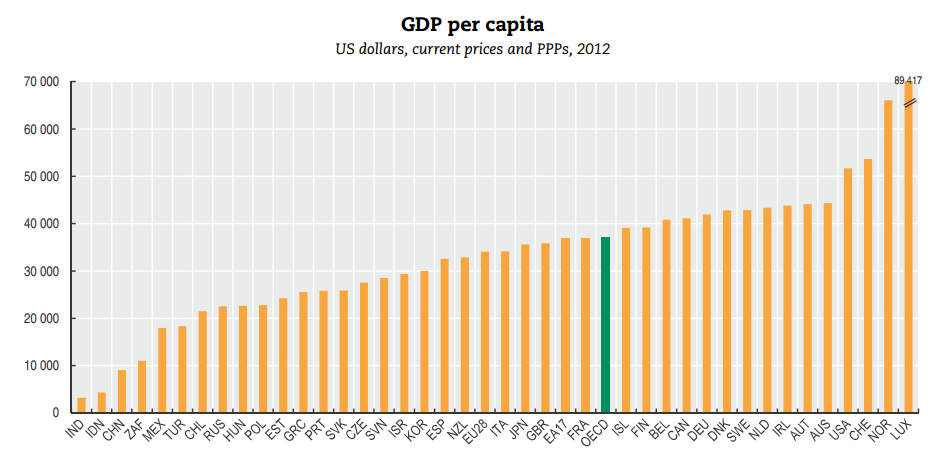
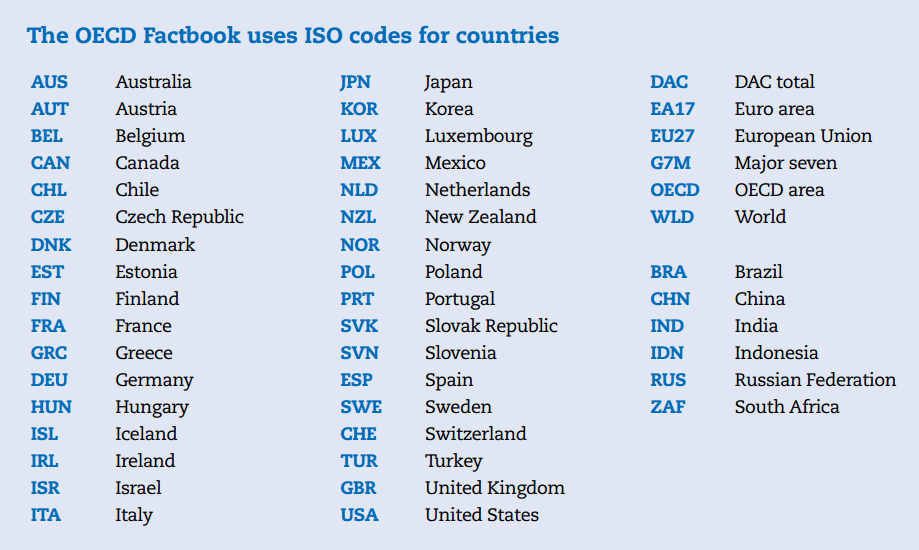
Ireland is still (2012) one of the richest countries in the world.
GDP per capita, 2012.
See IRL 7th from the RHS.
Richer than the UK (GBR).
See key.
From OECD Factbook 2014.
OpenIreland
proposes a "Technology Visa"
to allow IT-skilled workers and entrepreneurs come to Ireland from all over the world to
fill the vacancies in the IT companies here
and set up new companies.
Instead of agonising about the failed sectors of banking and property,
Ireland should be full steam ahead on the Celtic Tiger sector that still works: IT.