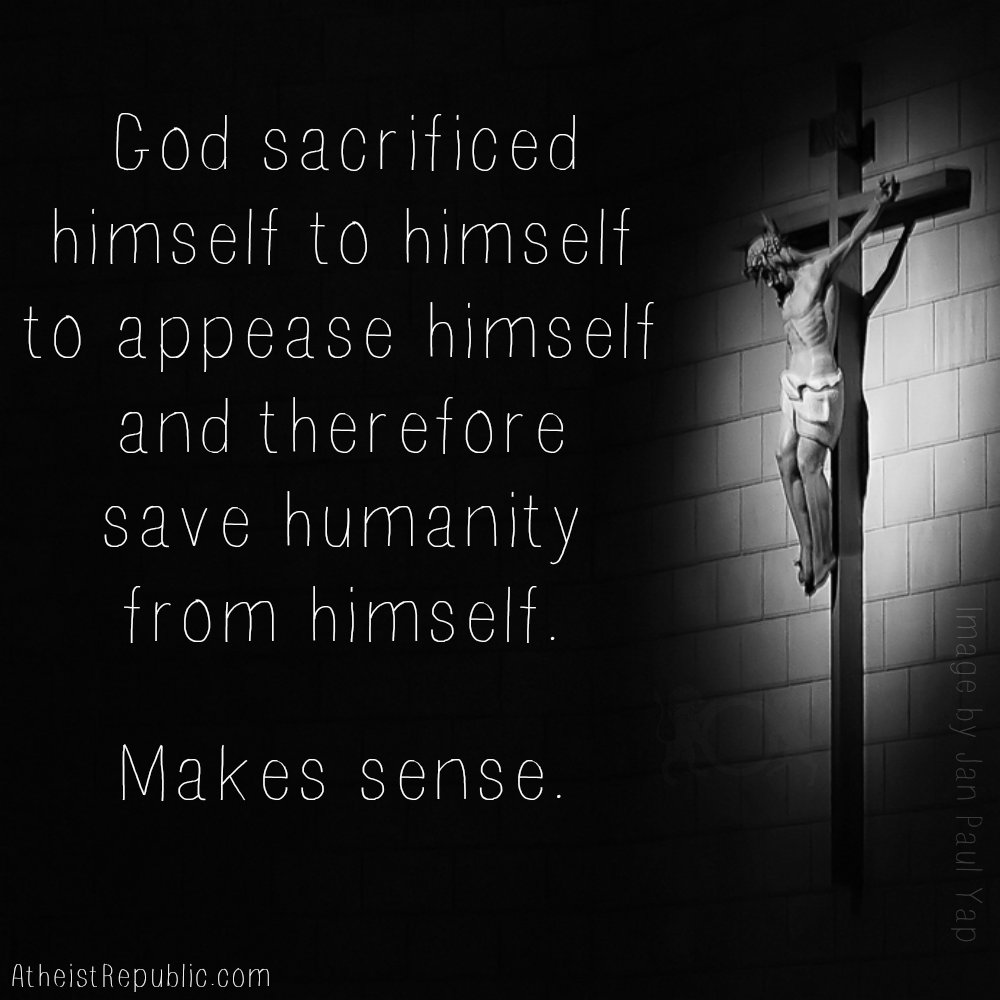
Seriously, is there anything more strange than the attempts by Christian thinkers
over the centuries
to assign meaning to Jesus' death?
Jesus was a nice person.
He told us nothing new
intellectually.
He told us nothing new
about science, medicine or history.
But his morality was promising. And he never killed anyone.
His murder was an outrage, and a terrible crime.
But it did not achieve anything.
It was just a murder.
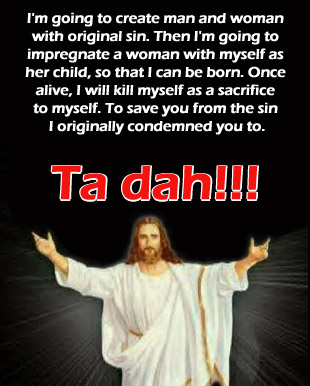
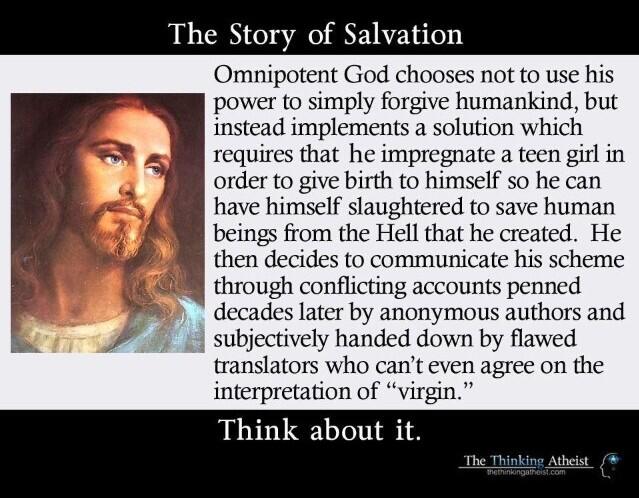
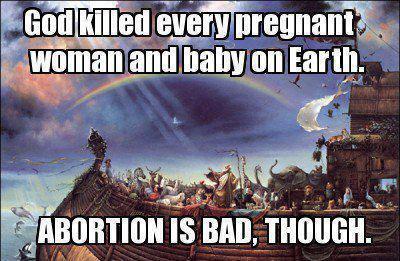
The attempts of Christianity to find some meaning in Jesus' death
have led them to ridiculous stories
like in the above image.
How many Christians even believe this?
From here.
For over a thousand years, the church banned books
and executed their authors.
Heresy, atheism, human rights, democracy,
science.
Many of the greatest, most noble thinkers in history were banned.
The works of the two greatest thinkers of all time,
Copernicus
and Darwin,
were placed on the Index of banned books,
as were the works of all the pioneers of democracy and human rights.
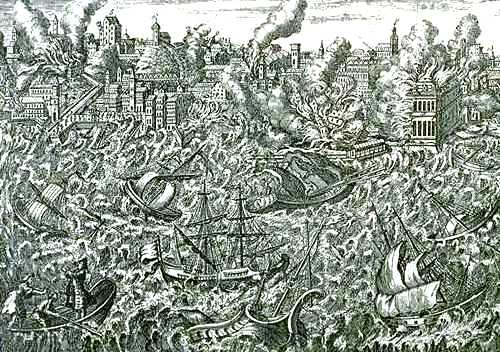
The 1755 Lisbon earthquake
spurred the growth of deism in the West,
as European thinkers considered for the first time that
God might not care
or perhaps even exist.
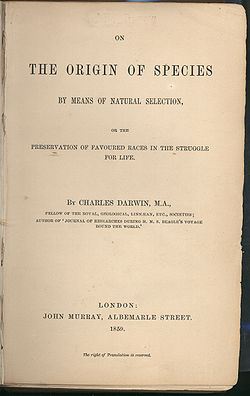
Darwin in 1859
was the man who finally allowed deists become atheists,
by providing an answer to the
Argument from Design.
The church executed
William Tyndale
in 1536 for publishing the Bible in English,
and they did their best to stop any translation of the book.
Unfortunately for them, it is now freely available
here.
Previously, in the 14th cent,
Pope Gregory XI
had tried to persuade
England to imprison
Wycliffe
for translating the Bible into English,
but was unsuccessful
(though the church successfully exterminated his followers).
Apparently the church now believes it was wrong
and the Bible should be made available in English after all,
and it no longer (apparently) believes that translators should be
put to death.
Limbo
is another great example of how the Catholic Church changes its beliefs over time,
and will change again in the future.
The Church used to insist that
infants who died
unbaptised would go to limbo, or even hell.
In any case, their parents would never see them again.
After torturing millions of bereaved mothers with these claims for centuries,
the church has finally decided that no, actually, it just made the whole thing up.
The Catholic Church has in fact changed a vast number of beliefs over the years:
It used to believe those who translated the Bible into English should be killed,
but doesn't think this any more.
It used to believe unbaptised babies go to hell, or limbo,
but doesn't think this any more.
It used to believe atheists and heretics should be
executed, but doesn't think this any more.
It used to believe priests could marry, but doesn't think this any more.
It used to believe the sun goes round the earth,
but doesn't think this any more.
It used to believe the world is a few thousand years old, but doesn't think this any more.
It used to believe humans have no animal ancestry,
but doesn't think this any more.
It used to believe in the
blood libel against the Jews,
and it even canonised "saints" who were supposed victims of "ritual murder" by the Jews,
but apparently it doesn't believe this any more.
Perceptive letter by Declan Mc Cormac, 17 Mar 2010,
about
Cardinal Brady's
attempts to weasel out of allegations that he covered up child sexual abuse in the 1970s.
"'It's not fair to judge actions of 35 years ago by the standards we are following today,' remarked Cardinal Brady ... a surprising defence from a senior member of an organisation which judges and condemns people based on standards set down 2000 years ago."
Decanonized saints
- If the church can actually name a saint, and get it wrong,
how can it possibly claim to be guided by God?
What else will the Catholic Church change in the future?
It is obvious that
in the future, the church will change its position on
contraception, homosexuality, women priests and married priests.
It will forget that it ever opposed them,
and the fact that it ever did will just become the humorous answer to a trivia question:
"The church once opposed contraception - oddly enough!"
There has been a lot of focus (rightly) on the appalling reaction of the Catholic church
to cases of child abuse by Catholic priests.
But there are some issues that are overlooked:
Child sex abuse by priests was not policy.
It was wrong even by the church's own standards (if only on grounds of celibacy).
Whereas other crimes the church has committed over the years have been policy.
There are other guilty parties in not reporting / dealing with abuse by priests, namely:
The parents, for complaining to the church rather than to the police.
The state and police, for many times asking the church to deal with it
rather than arresting the priests and prosecuting them.
Compared to the failure by these two parties,
the failure by the priests' employers seems the minor part.
The hopeless moral failure by the priests' employers is only shocking if you believed
they had serious moral integrity to begin with.
And since I didn't,
I am not shocked.
I am more shocked by the behaviour of the parents and the state/police.
Obviously this does not apply if there is
any suggestion that the church prevented people
going to the police.
The Murphy Report
says children who were abused by priests
were made to swear an oath that they would not tell anyone (including the police)
on pain of excommunication (and therefore hell).
See section 4.25.
This is intimidation of witnesses to and victims of a crime,
and was illegal, even in Ireland back then.
Any cleric involved in these oaths who is still alive should be prosecuted.
It has been alleged that
Cardinal Sean Brady,
head of the Catholic church in Ireland since 1996,
made child victims of sexual abuse swear, on pain of excommunication,
that they would not tell the police.
If this is true, he should go to prison.
History of snuff.
Pope Urban VIII threatened to excommunicate snufftakers.
Later, Pope Benedict XIII was a big fan of snuff.
Shouldn't excommunication be reserved for things the church is certain about?
Rather than passing fads of the day
that may change tomorrow.
Damon, P.E. et al. (1989),
Radiocarbon Dating of the Shroud of Turin,
Nature 337:611-615.
- This paper dates the Shroud to a period centering on 1325.
That is, it is a medieval forgery (note that it first appears in history in 1357).
I grew up quite convinced by the evidence I heard of its authenticity.
Now I realise I was just listening to
pseudoscience.
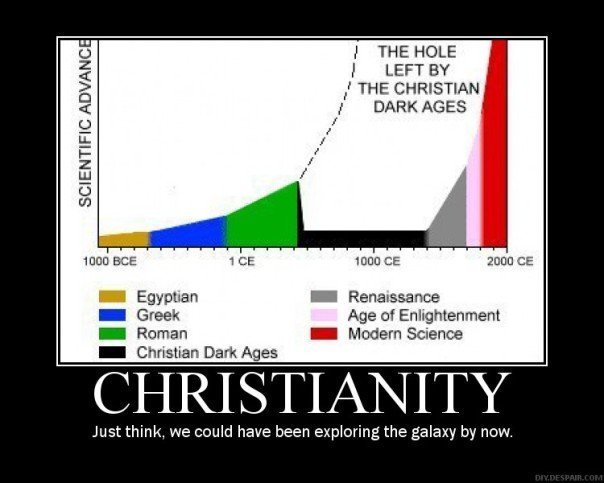
There is a lot of truth in this.
No one can look at 1400 AD Europe and be happy with what had happened since the Romans.
Imagine an alternate history where
15th-17th century science
started in the 5th-7th century AD.
Imagine where we would be today.
From
despair.com.
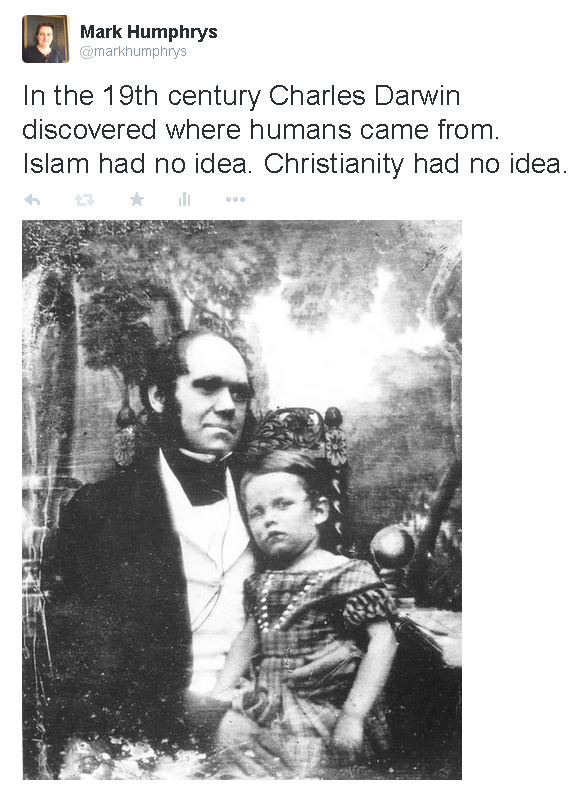
I ask:
How come no religion knew where humans came from before Darwin?
Jesus never told us that humans evolved from animals. He hadn't a clue where we came from. He was just a man, not a god.
Muhammad hadn't a clue where we came from either.
"This shameful font of indifferentism gives rise to that absurd and erroneous proposition which claims that liberty of conscience must be maintained for everyone.
...
Experience shows, even from earliest times, that cities renowned for wealth, dominion, and glory perished as a result of this single evil, namely immoderate freedom of opinion, license of free speech, and desire for novelty.
Here We must include that harmful and never sufficiently denounced freedom to publish any writings whatever and disseminate them to the people, which some dare to demand and promote with so great a clamor. We are horrified to see what monstrous doctrines and prodigious errors are disseminated far and wide in countless books, pamphlets, and other writings which, though small in weight, are very great in malice. We are in tears at the abuse which proceeds from them over the face of the earth."
- Pope Gregory XVI
explicitly opposes freedom of speech and freedom of religion
in his encyclical of 1832.
"From which totally false idea of social government they do not fear to foster
that erroneous opinion, most fatal in its effects on the Catholic Church and the salvation of souls, called by Our Predecessor, Gregory XVI, an "insanity,"
viz., that "liberty of conscience and worship is each man's personal right, which ought to be legally proclaimed and asserted in every rightly constituted society; and that a right resides in the citizens to an absolute liberty, which should be restrained by no authority whether ecclesiastical or civil, whereby they may be able openly and publicly to manifest and declare any of their ideas whatever, either by word of mouth, by the press, or in any other way.""
- Pope Pius IX
explicitly opposes freedom of speech and freedom of religion
in his encyclical of 1864.