For me, 1900 is the most haunting year in human history.
In 1900, the West believed in the future.
We believed in reason, in progress, in liberal democracy, in science.
We believed that humanity was going somewhere.
And then the 20th century did its best to destroy all these dreams.
For me 1900 wistfully stands for what might have been, what we might have achieved
if we had stuck by reason, science, and the values of the Enlightenment.
If we had stayed true to the Victorians, instead of betraying them,
there would have been no World War One or Two.
No Marxist revolutions.
There would have been no Holocaust.
There would have been no Soviet Union.
No communist famines.
No Islamofascist movement.
By 2000,
every country in the world would have been a democracy,
and war and famine would have ended forever.
A golden age, unlike any other in history, would have begun.
Humanity would be looking forward and outward,
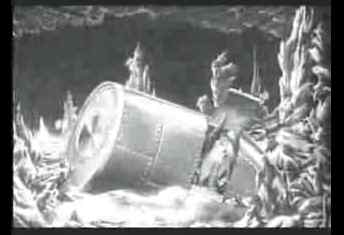
and by now we would have at least one
permanent base on another planet or moon.
We had a chance to do this.
We had a chance to end history, to reach the promised land
of worldwide democracy.
And we blew it.
We wasted a hundred years following Marx and other siren voices
of the counter-Enlightenment.
We betrayed the Victorians.
We betrayed the Enlightenment.
We wasted a hundred years.
The Titanic in 1912.
- Some people take the moral from the Titanic
that man should not have such pride and hubris.
That man should not believe he can conquer nature.
They almost seem delighted that it sank,
that the Edwardian era ended
and the world went to war and revolution.
I draw the opposite conclusion - that the Titanic era
was a glorious era and everything that came after it was shit.
Early motor races, including the
1903 Gordon Bennett Cup in Ireland
and the
1906 French Grand Prix.
Western science and technology
is not a story of exploitation, lack of humanity, and hubris,
as portrayed by so many movies.
It is a story of optimism, wonder and triumph.
Clip from the movie
Titanic (1997).
How much better the world would be if the 1912 world had been allowed to continue slowly developing,
if the 1914 war had never happened.
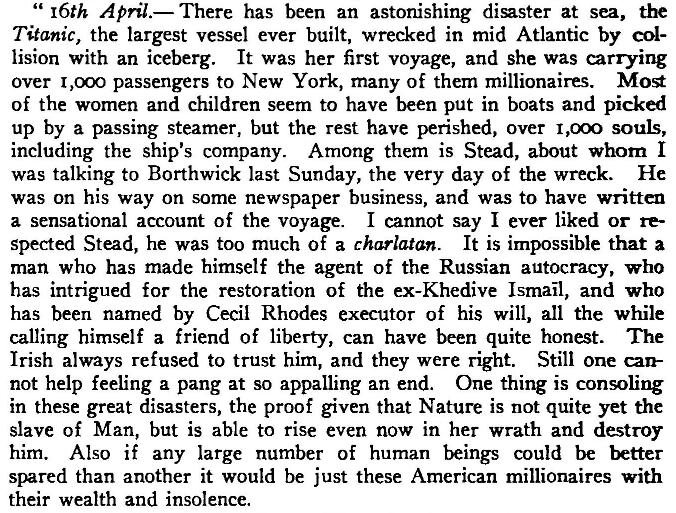
"16th April. - There has been an astonishing disaster at sea, the
Titanic, the largest vessel ever built, wrecked in mid Atlantic by
collision with an iceberg. It was her first voyage, and she was carrying
over 1,000 passengers to New York, many of them millionaires. Most
of the women and children seem to have been put in boats and picked
up by a passing steamer, but the rest have perished, over 1,000 souls
...
One thing is consoling
in these great disasters, the proof given that Nature is not quite yet the
slave of Man, but is able to rise even now in her wrath and destroy
him. Also if any large number of human beings could be better
spared than another it would be just these American millionaires with
their wealth and insolence."
- The disgusting diary of
Wilfrid Scawen Blunt,
on
16 Apr 1912
(see screenshot),
after the Titanic sank,
manages to sum up everything I hate about a certain type of western intellectual.
Like sneering leftists after 9/11,
he seems delighted the ship sank.
Thousands have died in horror, and he just feels like making stupid jokes.
He has contempt for vulgar Americans who earned their wealth through trade
(in contrast to old money like his wife the
15th Baroness Wentworth).
And finally, he is delighted that cruel uncaring nature is putting man in his place.
He's dead 90 years, but I still want to punch him.
The older western imperialism and colonisation wasn't all bad.
It introduced societies to advanced ideas
as well as often
brutally exploiting.
Self-determination can lead to totalitarianism
just as easily as foreign occupation can
(as Africa shows).
The human rights and prosperity of a country
are what matter
above all else
- certainly they matter more than self-determination or democracy,
which are only means to that end.
By these standards, Soviet imperialism was all bad,
but British imperialism wasn't.
Two Cheers for Colonialism
by Dinesh D'Souza
- an Indian says that British imperialism
wasn't all bad for India.
As an Irishman, I feel exactly the same
about Britain's history in Ireland.
Africa
has not prospered since self-determination.
Africa illustrates clearly that self-determination
is not the solution to all your problems.
WWI, 1914
- the start of the madness.
For me,
WW2
was a just war against evil, but
I can never view WWI that way.
Sure, if you had to pick a side, you would support the
Allies
against the
Central Powers.
But it simply
was not worth 15 million lives
to stop the Central Powers.
Surely, in 1914 or early 1915, when it became clear how serious this was,
some kind of compromise peace deal
could have been reached.
Such a deal was proposed but would have been shameful with Nazi Germany,
but would not have been shameful with WWI Germany.
War was a worse option.
Exception: War on the Turkish (Ottoman) front.
Some guy called
"Tallest44"
made me revise my thoughts
about WWI being pointless.
I was being too Germany-centric.
Tallest44
reminds us that
Turkey (the Ottoman Empire)
in WWI was a
genocidal tyranny,
even if Germany wasn't.
The war against Germany
may have been a futile waste of life,
but the war against Turkey (the Ottoman Empire)
was a war against a terrible evil.
He is right.
WWI was a war against evil - on the Turkish (Ottoman) front.
The counter argument, though, is that WWI itself was the cause of the Turkish genocide.
The Turkish genocide of Christians might never have happened
if WWI had never happened.
WWI began in July 1914.
The Ottoman Empire entered the war in Nov 1914.
The Armenian Genocide began in April 1915,
in a country then engaged in total war against its enemies.
Had Britain resisted going to war in 1914, the Christians of Turkey might have lived.
Tallest44
points out the
Herero and Namaqua Genocide
by Germany in Namibia, Africa, in 1904-07,
when maybe 100,000 died.
True, but the obvious answer is:
15 million lives
to stop Germany?
It wasn't worth it.
Especially when the Namibia genocide (unlike the Turkish genocide) was over, and not ongoing during WWI.
One could also note that other European countries committed atrocities in Africa.
e.g. Belgium's genocide in Congo
in 1885-1908.
Couldn't one equally support those fighting against Belgium in WWI?
The bottom line is, there was no cause - on the Western front at least - for which 15 million lives
lost seems anything but an atrocity.
And it is not just the 15 million lives lost immediately in WWI.
WWI soaked Ireland (1916-23)
and Turkey (1915-23)
in blood and destruction,
and was the start of the long 20th century collective madness
that led to the Russian revolution (1917),
the Bolshevik and Soviet democide,
the rise of Nazism,
WW2, the Holocaust,
the Cold War, and the entire worldwide communist democide.
WWI is arguably even the cause of IRA violence
in the modern age.
(The worship of the gun started in 1916.)
WWI derailed western civilization from the long 18th-19th century
pursuit of science, enlightenment, democracy, capitalism
and ever-expanding freedom.
After 1914, an entire human lifetime
was lost before the tide began in 1989
to flow in the direction of human progress again.
And finally,
1914 was something from which Europe never recovered.
It was the great stupid act of European suicide.
Until 1914, Europe had had 500 years of being the centre of the world
- the birthplace of science and the heart of all human knowledge.
And Europe threw it all away.
It never recovered from the two world wars of the 20th century.
Leadership of the world passed to America.
As the men were marching out in 1914, they should have been told:
This is the end of European power you are marching for.
Don't try to beat the enemy.
Just do some kind of deal with him and carry on with life as normal.
Say It Loud - Bourgeois and Proud!
by J.P. Zmirak, June 13, 2002:
"The 20th century, for all the scientific pretenses with which it began, was in
fact a Dark Age of superstition,
obscurantism, and myth."
Bourgeois, property-owning, respectable, middle-class values
are the best values in the world,
and the only values truly compatible with science and a free society.
Niall Ferguson
seems to have similar views to me
- that Britain, and Europe, and the world, would have been better off
if Britain had declined to join the war in 1914.
Germany would have won on the Continent, but life under German dominance in central Europe
would not have been that bad.
Britain would have stayed a great world power.
Hitler and Lenin would have lived lives of obscurity.
In
The Pity of War (1998)
Ferguson describes WWI as
"the greatest error of modern history".
Charge scene from
War Horse (2011).
I strongly support the allied effort in WW2.
I support the Korean and Falklands wars.
I support the Afghan and Iraq wars.
I even support the Vietnam war.
But I do not support WWI.
I agree with every pacifist and
protester
about this war.
I agree with every anti-war movie about this war.
It is history's biggest example of pointless slaughter, of killing and dying for nothing.
Since 1989 we have a second chance to make it right,
to be worthy descendants of the Victorians,
to reach the promised land of
global democracy.
Let's hope we don't screw it up this time.
Actual imperialism by the west is gone
and won't be returning.
But
cultural imperialism
is still possible.
And this would be almost entirely a good thing.
In particular, cultural imperialism
is the key to
the great Islamic apostasy,
which is sorely needed,
and will make the world such a better and safer place.
Victor Davis Hanson, February 1, 2002:
"What, then, will replace the present bankrupt and amoral
assumptions and ideologies? Let us hope perhaps that we can
return to the honesty and realism of classical 19th-century
Western liberalism, which, for all its naivete and
self-centeredness, still did not cause a fraction of the carnage as
did the utopian promises of our most murderous 20th century."
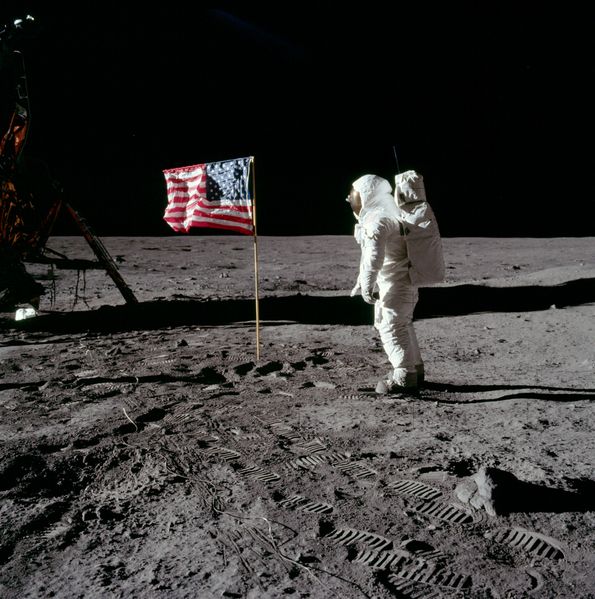
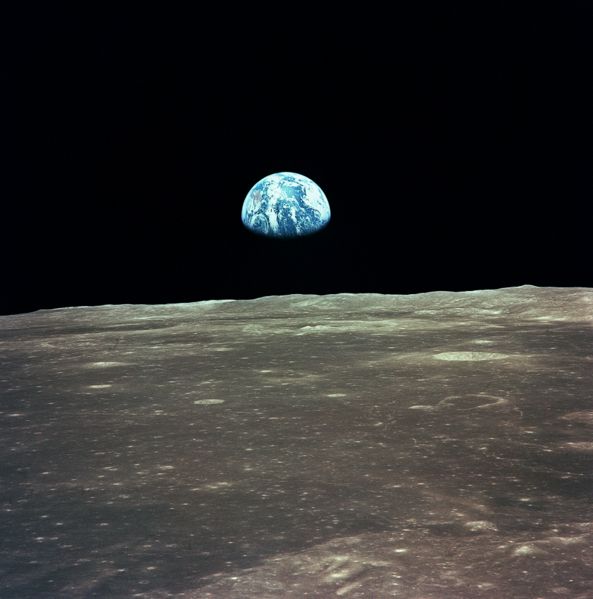
This
is still the defining, triumphant moment in
the history of humanity,
the first step of our destiny
- to spread life to the stars
and ensure that life never dies out.
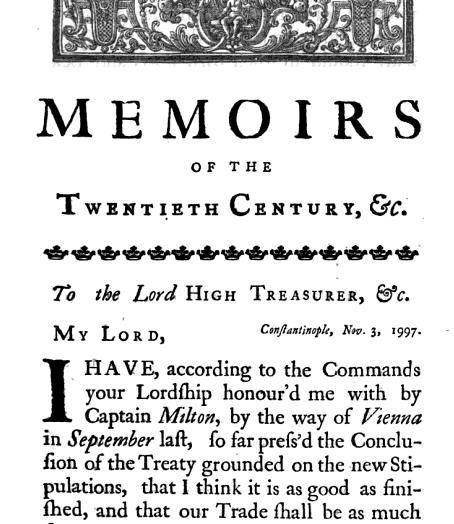
Yes that does say "1997".
This is the opening page
of one of the first science fiction works,
Memoirs of the twentieth century
(1733)
by
Samuel Madden,
in which he tries to imagine life in the 20th century.
Such wonderful optimism,
to believe that we have a future,
and that it will be different to today.